
 Editor’s pick
Earthmoving
Wheeled excavators: the road-going diggers of city construction
Wheeled excavators drive between jobs on public roads and work without damaging asphalt. They dominate urban utility work in Europe. Here is how they compare with crawlers and which models lead.
Model guides
Popular wheeled excavators reviewed
Editor’s pick
Liebherr
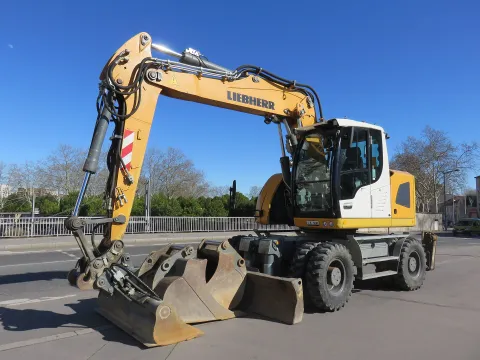
Liebherr A 918 Compact
- Weight
- 19 t
- Tail swing
- Compact radius
- Travel speed
- up to ≈20–35 km/h
Wheeled Excavators compared
6 models · click a column to sort
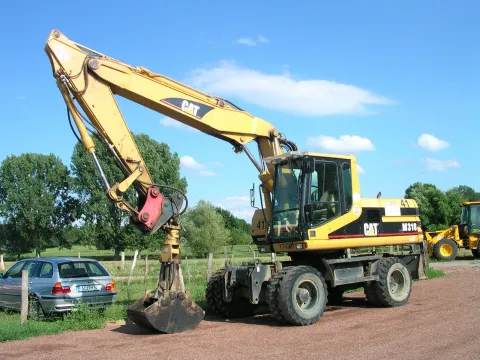
| Caterpillar M318 | Caterpillar | 20,000 kg | 129 kW / 173 hp |
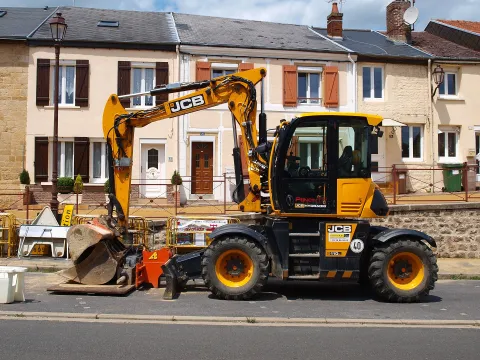
| JCB Hydradig 110W | JCB | 11,000 kg | 81 kW / 109 hp |
| Liebherr A 918 Compact | Liebherr | 19,000 kg | — |
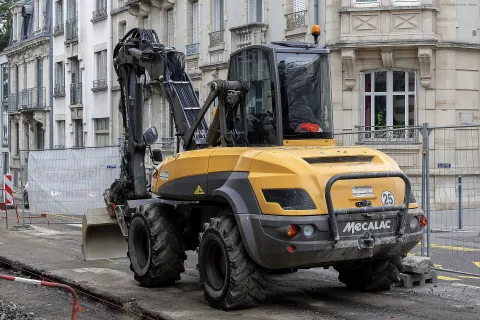
| Mecalac 12MTX | Mecalac | 12,000 kg | — |
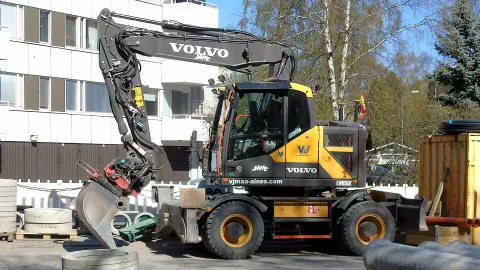
| Volvo EWR150E | Volvo Construction Equipment | 16,000 kg | 115 kW / 154 hp |
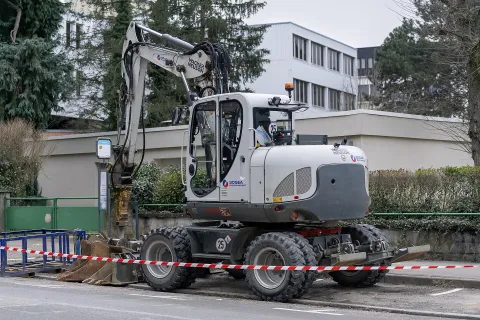
| Wacker Neuson EW100 | Wacker Neuson | 10,000 kg | — |
A wheeled excavator (also called a rubber-tyred or mobile excavator) has the same rotating house, boom and arm as a crawler excavator, but sits on a chassis with four large rubber tyres and an axle drivetrain. Top speeds of 20–40 km/h (12–25 mph) let it drive itself from job to job on public roads, and the tyres do not damage asphalt or paving.
Where wheeled excavators shine
- Urban utility work: water, gas, fibre and sewer connections along streets.
- Road maintenance and kerb laying.
- Municipal work: parks, cemeteries and winter services.
- Material handling with grabs at recycling yards and timber yards.
- Rail work (road-rail versions with rail wheels).
Wheeled excavators are especially popular in Germany, Austria, Switzerland, France and the Nordic countries, where many contractors use them as their main machine.
Stability: outriggers and blades
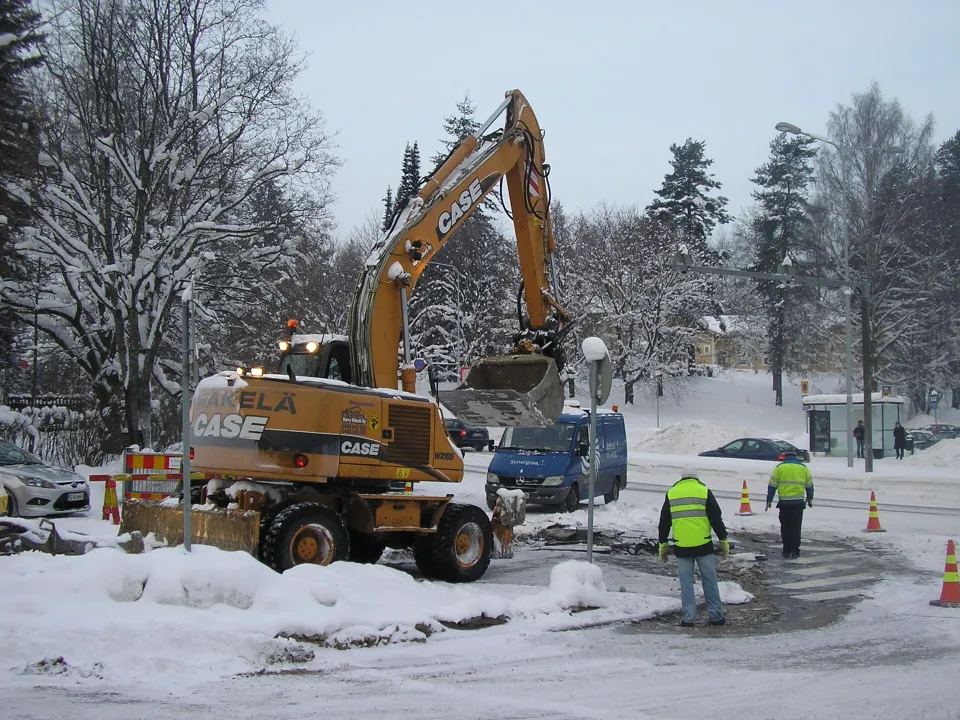
Because tyres are less stable than tracks, wheeled excavators use outriggers, a dozer blade, or both (one at each end) to stabilise the machine when digging or lifting. Many have an oscillating front axle lock for working on uneven ground.
Booms and tail swing
- Two-piece (adjustable) booms fold closer to the machine and give more reach and depth flexibility, ideal for confined urban sites.
- Short-tail-swing designs such as the Volvo EWR series keep the counterweight within the machine's width.
- Tiltrotators are extremely common on wheeled excavators in Scandinavia and Germany.
Size classes
Compact wheeled excavators start around 6–10 t (13,000–22,000 lb); mainstream urban machines weigh 13–18 t (29,000–40,000 lb); large models reach 20–25 t (44,000–55,000 lb).
Wheeled vs crawler excavator
Choose wheeled if your work involves frequent moves between nearby sites on roads, hard surfaces or tight streets. Choose a crawler for soft ground, steep slopes, heavy digging and maximum lifting stability.
Frequently asked questions
Can a wheeled excavator drive on the road?
Yes. Most wheeled excavators are approved for road use with lights, mirrors and speed limits, though licensing and registration rules vary by country.
Are wheeled excavators as strong as crawlers?
For the same weight they generally have similar digging forces but slightly lower lifting capacity unless outriggers are deployed.
Earthmoving