
 Editor’s pick
Earthmoving
Motor graders: the precision finishers of earthmoving
Motor graders cut, spread and finish surfaces to tight tolerances, from new road bases to gravel road maintenance. Learn how they work, how they are sized and what to look for.
Model guides
Popular motor graders reviewed
Editor’s pick
Motor Graders compared
4 models · click a column to sort
| Caterpillar 140 | Caterpillar | 18,500 kg | 158 kW / 212 hp |
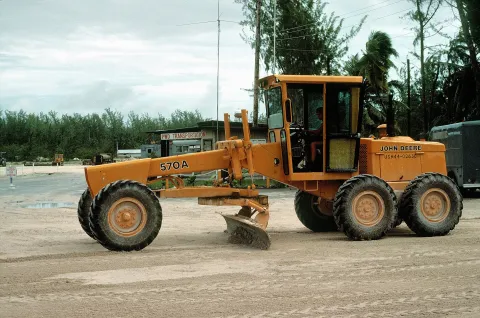
| John Deere 772G | John Deere | 19,250 kg | 175 kW / 235 hp |
| Komatsu GD655-7 | Komatsu | 16,750 kg | 163 kW / 219 hp |
| XCMG GR215 | XCMG | 16,500 kg | 160 kW / 215 hp |
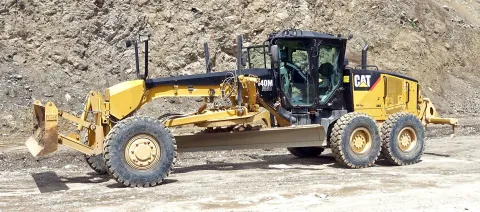
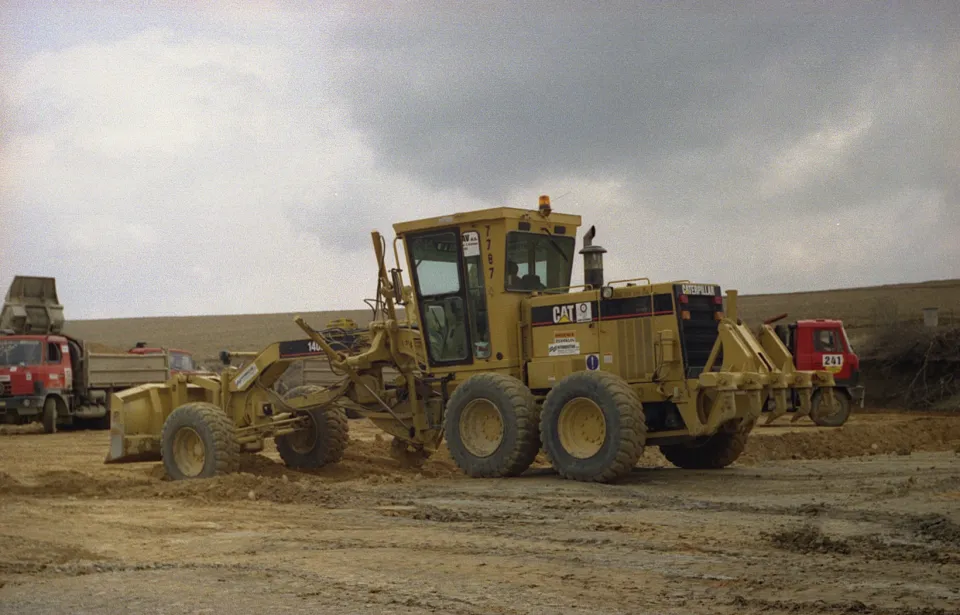
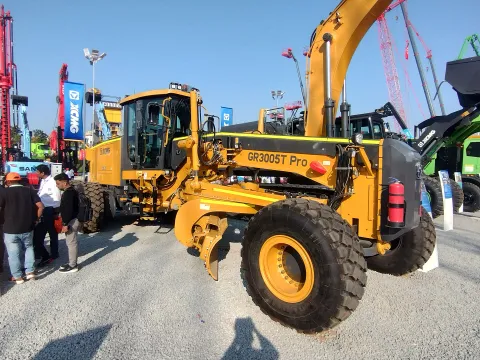
A motor grader (road grader, or simply grader) is a long, six-wheeled machine with a blade, called a moldboard, mounted between the front and rear axles. By adjusting the blade's angle, tilt, height and side shift, a skilled operator can cut and spread material with centimetre accuracy. Graders build road bases, cut ditches, shape slopes, maintain gravel and haul roads, and clear snow.
How a motor grader works
- The moldboard hangs from a rotating circle under the frame. The circle turns to angle the blade, and hydraulic cylinders lift, tilt and side-shift it.
- An articulated frame lets the front and rear sections bend, so the grader can "crab" sideways to work along ditches and slopes.
- Leaning front wheels counter the side force from an angled blade.
- Tandem rear axles with four driven wheels provide traction; some graders add front-wheel hydraulic drive (all-wheel drive, AWD or 6WD).
- Optional rippers or scarifiers break up hard surfaces, and a front blade or push plate adds versatility.
Size classes
| Class | Operating weight | Moldboard width | Typical use |
|---|---|---|---|
| Small | 10–14 t (22,000–31,000 lb) | 3.1–3.7 m (10–12 ft) | Municipal roads, sites |
| Medium | 14–20 t (31,000–44,000 lb) | 3.7–4.3 m (12–14 ft) | Road construction, highway work |
| Large | 20–30 t (44,000–66,000 lb) | 4.3–4.9 m (14–16 ft) | Large projects, haul roads |
| Mining | 30–70 t | 4.9–7.3 m (16–24 ft) | Mine haul road maintenance |
Controls
Traditional graders use a bank of levers, one per function. Modern machines from Caterpillar, John Deere and others offer joystick controls, which reduce operator fatigue and shorten training time.
Machine control
Graders benefit enormously from 2D (cross-slope) and 3D GNSS or total-station grade control, which allows fine grading to design without stakes. Cross-slope systems are now available factory-installed from most major brands. See machine control explained.
Frequently asked questions
Why do motor graders have the blade in the middle?
Placing the blade between the axles means the front wheels ride on the old surface and the rear wheels on the newly cut one, so bumps are averaged out and the blade produces a smoother, more accurate finish.
What is a 6WD grader?
A six-wheel-drive (or all-wheel-drive) grader adds hydraulic drive to the front wheels for more traction on soft ground, slopes and snow.
Earthmoving