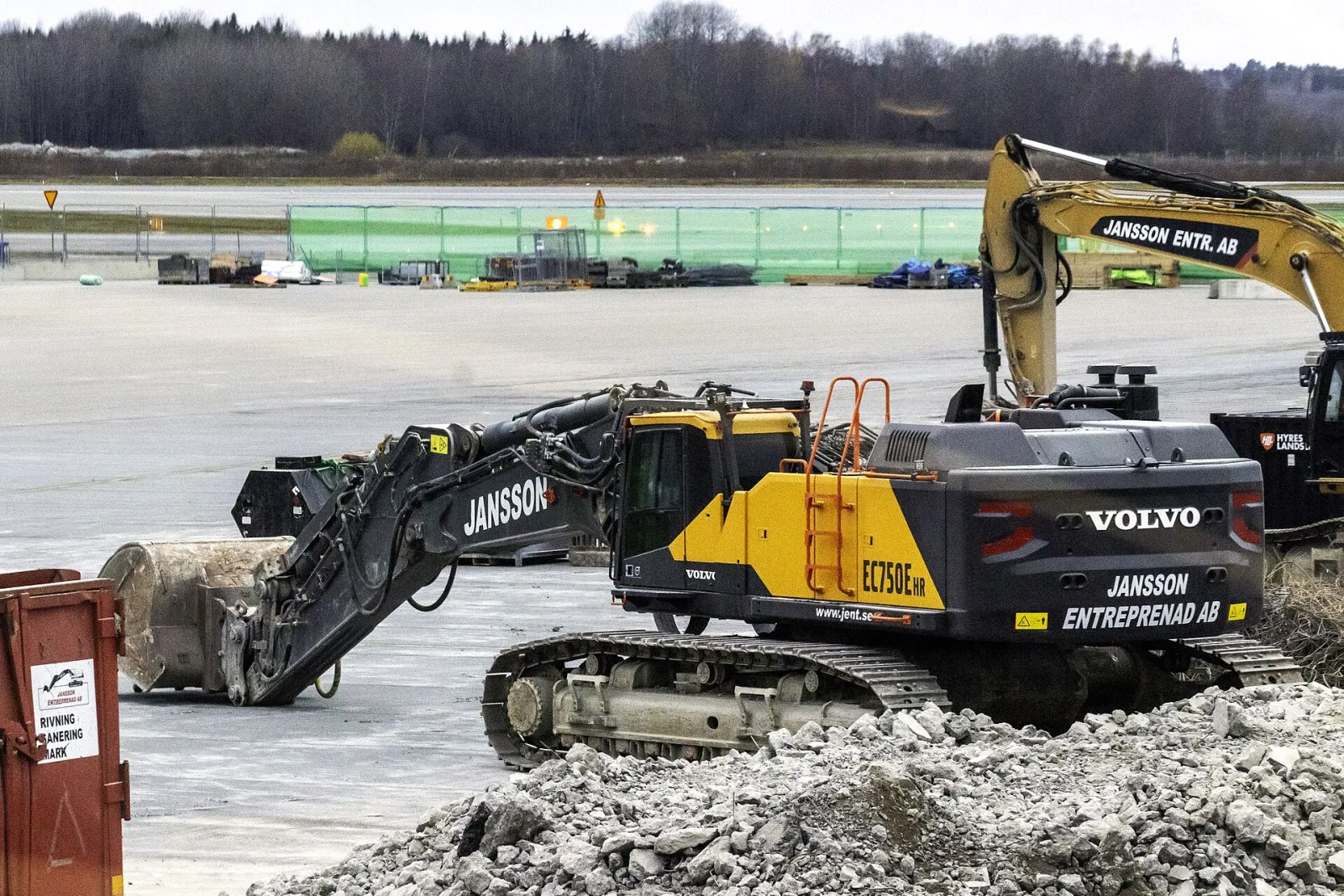
Volvo EC750E
Volvo’s 75-tonne quarry excavator with a D16 engine
The Volvo EC750E is a 73.5–75.3 tonne crawler excavator powered by the 16-litre Volvo D16 (516 hp), with 900 L/min electro-hydraulics, 342 kN breakout force and buckets up to 5.16 m³. Specs, rivals and buying advice.

On this page (13 sections) ↓
+Strengths
- Huge torque from the 16-litre Volvo D16
- Electro-hydraulic system with on-demand flow cuts losses
- Up to 5.16 m³ bucket after the latest upgrade
- Very high lifting capacity (30.8 t along undercarriage)
- Volvo cab comfort on a 75-tonne machine
−Watch-outs
- 4.29 m wide — multi-load transport
- Smaller dealer presence than Cat in mining regions
- High ownership cost; needs high volumes
The Volvo EC750E in 30 seconds
- What it is: Volvo's largest crawler excavator, 73.5–75.3 tonnes.
- Engine: 16-litre Volvo D16, 516 hp gross.
- Headline numbers: 7.21 m dig depth, 11.46 m reach, 342 kN breakout, ≈900 L/min, buckets up to 5.16 m³.
- Why buy it: a powerful, efficient quarry and mass-excavation machine.
- Why not: make sure your trucks and volumes justify a 75-tonne excavator.
Overview
The EC750E replaced the EC700C in the mid-2010s and is Volvo's top crawler excavator. It is designed for quarry face loading, primary loading of 40-tonne-plus haulers and big infrastructure projects. Volvo has since upgraded the machine with an optimised engine–pump match and a larger bucket, and the EC750E was shown at ConExpo 2026.
Engine and hydraulics
The Volvo D16 six-cylinder (16 L) delivers 516 hp gross and huge torque at low speed. Volvo's electro-hydraulic system controls on-demand flow and reduces internal losses; Volvo said it gave about 4% more hydraulic flow than the predecessor. Two main pumps supply about 900 L/min. SAE breakout force is 323 kN (342 kN with boost) and tear-out 311/329 kN.
The machine digs to 7.21 m and reaches 11.46 m. Lifting capacity along the undercarriage is a substantial 30,760 kg at 6 m reach. Buckets range from 3.3 to 5.16 m³.
Applications and pairing
The EC750E is a natural partner for Volvo's A40 and A45 articulated haulers and for 50–60 tonne rigid trucks. See pass matching and types of dump trucks.
Front ends and bucket choice
Volvo offers the EC750E with mass-excavation and general-purpose booms and arms. The mass-excavation (ME) front maximises breakout force for blasted rock and quarry faces; the longer front gives the reach and depth figures quoted above for bulk earthworks and bench loading. Buckets from 3.3 to 5.16 m³ cover heavy rock to lighter soils: in dense, blasted material choose a smaller, heavier rock bucket; in soils and gravel the largest bucket keeps truck loading fast.
| Application | Typical setup |
|---|---|
| Quarry face loading, blasted rock | ME boom and arm, rock bucket with heavy wear package |
| Overburden and bulk earthworks | GP front, largest bucket the material allows |
| Heavy hammer or secondary breaking | Hammer piping, guarding, short arm |
Operating costs
For a 75-tonne machine, fuel, undercarriage and GET dominate operating costs. Use ECO mode where cycle time allows, set auto-idle and auto-shutdown, and check fuel burn and idle percentage in CareTrack. Undercarriage life depends heavily on the ground: in sharp rock, keep the floor clean with a dozer or loader and limit travel. Bucket teeth and lips should be changed before the adapters wear — see bucket teeth and GET.
Transport and assembly
At 4.29 m wide and over 73 t, the EC750E is transported in several loads (base machine, counterweight, front end), with permits and escorts in most countries. Allow time for reassembly and functional checks on site. See how to transport heavy equipment.
Maintenance and uptime
Large excavators earn money only when they run, so planned maintenance matters even more than on small machines. Volvo designed the E-series large excavators with grouped service points and easy access to filters; many owners add fluid sampling at every service and fit an auto-lube system. Keep spare GET, filters and common hoses on site to reduce downtime. See oil analysis, hydraulic hose failures and final drive maintenance.
EC750E vs rivals
| Rival | Comparison |
|---|---|
| Caterpillar 374 | C15 484 hp, 897 L/min, variable-gauge undercarriage |
| Caterpillar 395 | 94 t step up for larger trucks |
Buying tips
Inspect undercarriage, final drives, swing ring, boom and stick structures, and bucket/GET wear. Check CareTrack data and engine hours. See construction vs mining equipment and bucket teeth and GET.
Volvo EC750E specifications
Key figures
| Operating weight | 73,500–75,300 kg (162,000–166,000 lb) |
|---|---|
| Engine power | 516 hp (≈385 kW) gross |
| Max. digging depth | 7.21 m (23 ft 8 in) |
| Max. digging reach | 11.46 m (37 ft 7 in) |
| Breakout force (SAE J1179) | 323 kN normal / 342 kN boost |
| Bucket capacity | 3.3–5.16 m³ (4.3–6.75 yd³) |
Engine
| Engine model | Volvo D16, 16 L, six cylinders |
|---|---|
| Emissions | US EPA Tier 4 Final / EU Stage V |
Hydraulics and forces
| Main pumps | 2 variable axial piston pumps, ≈900 L/min (238 US gal/min) combined |
|---|---|
| Tear-out force (SAE J1179) | 311 kN normal / 329 kN boost |
Lifting and dimensions
| Lifting capacity along undercarriage | 30,760 kg (67,800 lb) at 6 m reach / 1.5 m height |
|---|---|
| Overall width | 4.29 m (14 ft 1 in) |
| Tail swing radius | 4.14 m (13 ft 7 in) |
Capacities
| Fuel tank | ≈800 L (211 US gal) |
|---|
Figures are typical for standard configurations as published by Volvo Construction Equipment. Values vary by market, emissions tier, attachments and options; confirm with your dealer before purchase, transport or lifting.
Volvo EC750E vs rivals: specs side by side
Headline figures for standard configurations; “—” means the figure is not listed in our database.
| Specification | Volvo EC750E | Caterpillar 374 | Caterpillar 395 | Volvo EC480E |
|---|---|---|---|---|
| Type | Excavator | Excavator | Excavator | Excavator |
| Operating weight | 73,500–75,300 kg (162,000–166,000 lb) | ≈73,900 kg (162,900 lb) | ≈94,100 kg (207,400 lb) | 45,500–53,300 kg (100,310–117,510 lb) |
| Engine power | 516 hp (≈385 kW) gross | 362 kW (485 hp) | 405 kW (543 hp) | ≈277–283 kW (371–380 hp) |
| Max. digging depth | 7.21 m (23 ft 8 in) | 8.56 m (28 ft 1 in) | 9.72 m (31 ft 11 in) | ≈7.82 m (25 ft 8 in) |
| Breakout force (SAE J1179) | 323 kN normal / 342 kN boost | — | — | ≈230 kN (51,615 lbf) |
| Bucket capacity | 3.3–5.16 m³ (4.3–6.75 yd³) | 3.3 m³ (4.32 yd³) SD | 5.2 m³ (6.8 yd³) SD | — |
| Engine model | Volvo D16, 16 L | Cat C15, 15.2 L (928 in³) | Cat C18, 18.1 L (1,105 in³) | — |
| Emissions | US EPA Tier 4 Final / EU Stage V | US EPA Tier 4 Final / EU Stage V / Korea Stage V / Japan 2014 | US EPA Tier 4 Final / EU Stage V / Korea Stage V / Japan 2014 | US EPA Tier 4 Final / EU Stage IV–V |
| Tail swing radius | 4.14 m (13 ft 7 in) | 4.21 m (13 ft 10 in) | 4.85 m (15 ft 11 in) | — |
| Fuel tank | ≈800 L (211 US gal) | 920 L (243 US gal) | 1,219 L (322 US gal) | ≈680 L (179.7 US gal) |
Volvo EC750E videos
Walkarounds and demonstrations from the manufacturer and independent channels. Videos load from YouTube only when you press play.
Frequently asked questions
How much does a Volvo EC750E weigh?
Volvo lists 73,500–75,300 kg depending on configuration.
What engine is in the Volvo EC750E?
The 16-litre Volvo D16 six-cylinder, rated at 516 hp gross in Volvo’s North American specification.
How deep can a Volvo EC750E dig?
Maximum digging depth is 7.21 m (23 ft 8 in) and reach 11.46 m (37 ft 7 in) in Volvo’s reference configuration.
What bucket size does the EC750E use?
3.3 to 5.16 m³ (4.3–6.75 yd³), depending on material and boom/arm.
What is the EC750E breakout force?
323 kN normal and 342 kN with boost (SAE J1179).
Owner & operator reviews
No reviews yet. Have you owned, operated or serviced a Volvo EC750E? Your experience helps other buyers.
Share your experience with the Volvo EC750E +
Forum discussions
Have a question about the Volvo EC750E? Ask the community.