How to Grade With an Excavator: Techniques for Flat Floors and Clean Slopes
Grading with an excavator is a skill that separates good operators from great ones. Here are the techniques, buckets and technology that make it easier.

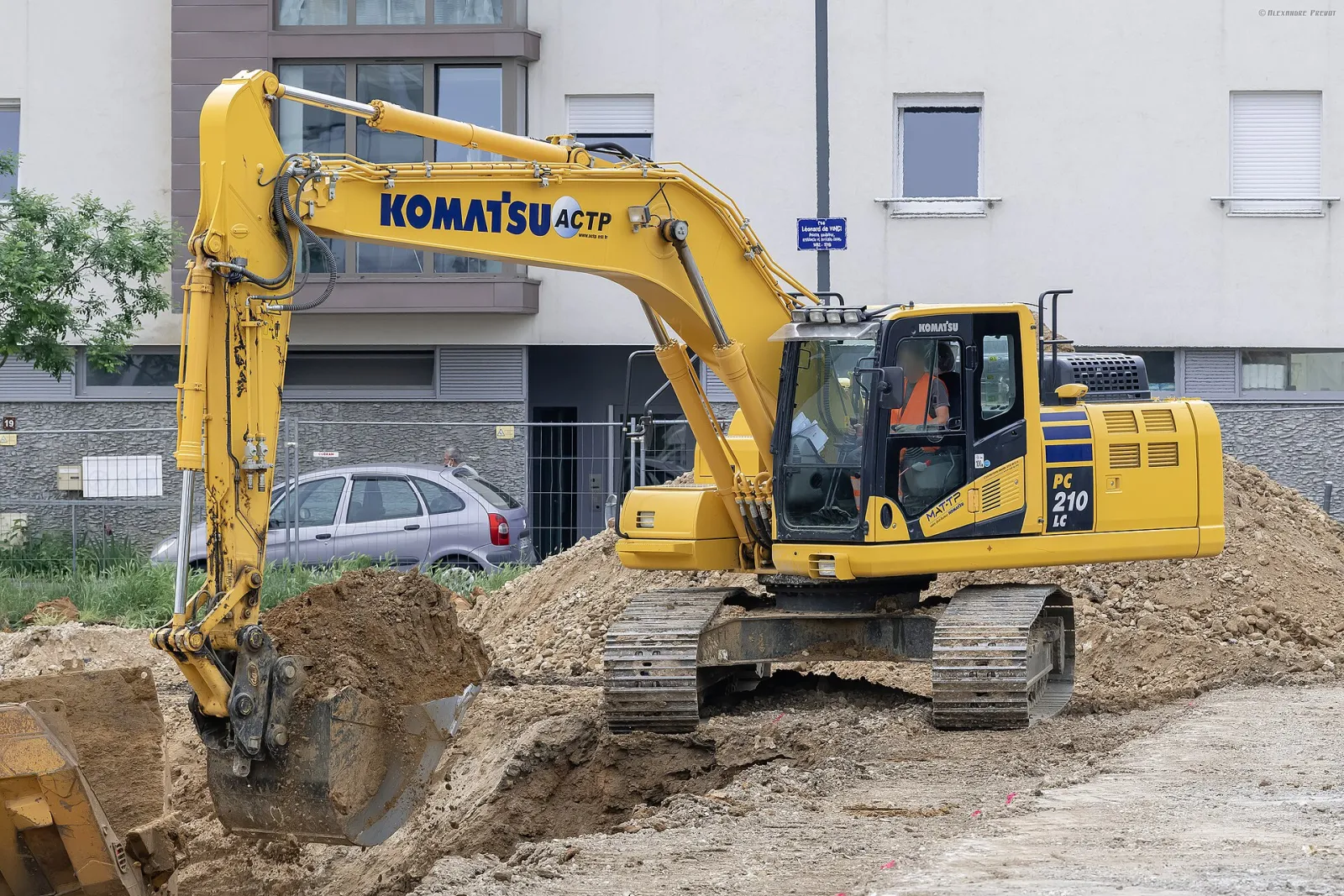
Photo: Alexandre Prevot from Nancy, France, CC BY-SA 2.0 · license
Excavators are increasingly used for fine grading: trench bottoms, foundation pads, slopes and ditches. Doing it well saves hours of hand work and survey checks.
Choose the right bucket
- Ditching (grading) bucket: wide with a smooth, flat edge.
- Tilt bucket: tilts left and right to match cross slopes without moving the machine.
- Tiltrotator: adds rotation for maximum flexibility.
Set up the machine
- Position tracks square to the work and on level ground where possible.
- Work with the final drives at the rear for stability.
- Use a power mode that gives smooth, controllable hydraulics.
Technique for a flat floor
- Rough cut slightly high with a digging bucket.
- Switch to the grading bucket and draw the bucket towards you, coordinating boom up and arm in so the cutting edge travels in a straight line.
- Keep the bucket angle constant; small corrections with the bucket cylinder keep the edge flat.
- Overlap each pass slightly.
Technique for slopes
Work from the top down, moving the boom and arm together to keep the edge on the slope line. A tilt bucket lets you match slopes that are not square to the machine.
Use technology
2D grade indication shows the bucket's depth and angle against a target. Semi-automatic systems such as Cat Grade with Assist or Komatsu iMC control the boom and bucket while you control the arm, producing flat or sloped surfaces quickly. Read machine control explained.
Check your work
Use a laser receiver or rover to check grade frequently until your results are consistent.