Caterpillar 323
The heavier, higher-production sibling of the Cat 320
The Cat 323 takes the Next Generation 320 platform and adds weight, a six-cylinder C7.1 engine and a 5.4-tonne counterweight for faster truck loading and heavier lifting. Full specs, 323 vs 320, rivals, problems and buying advice.

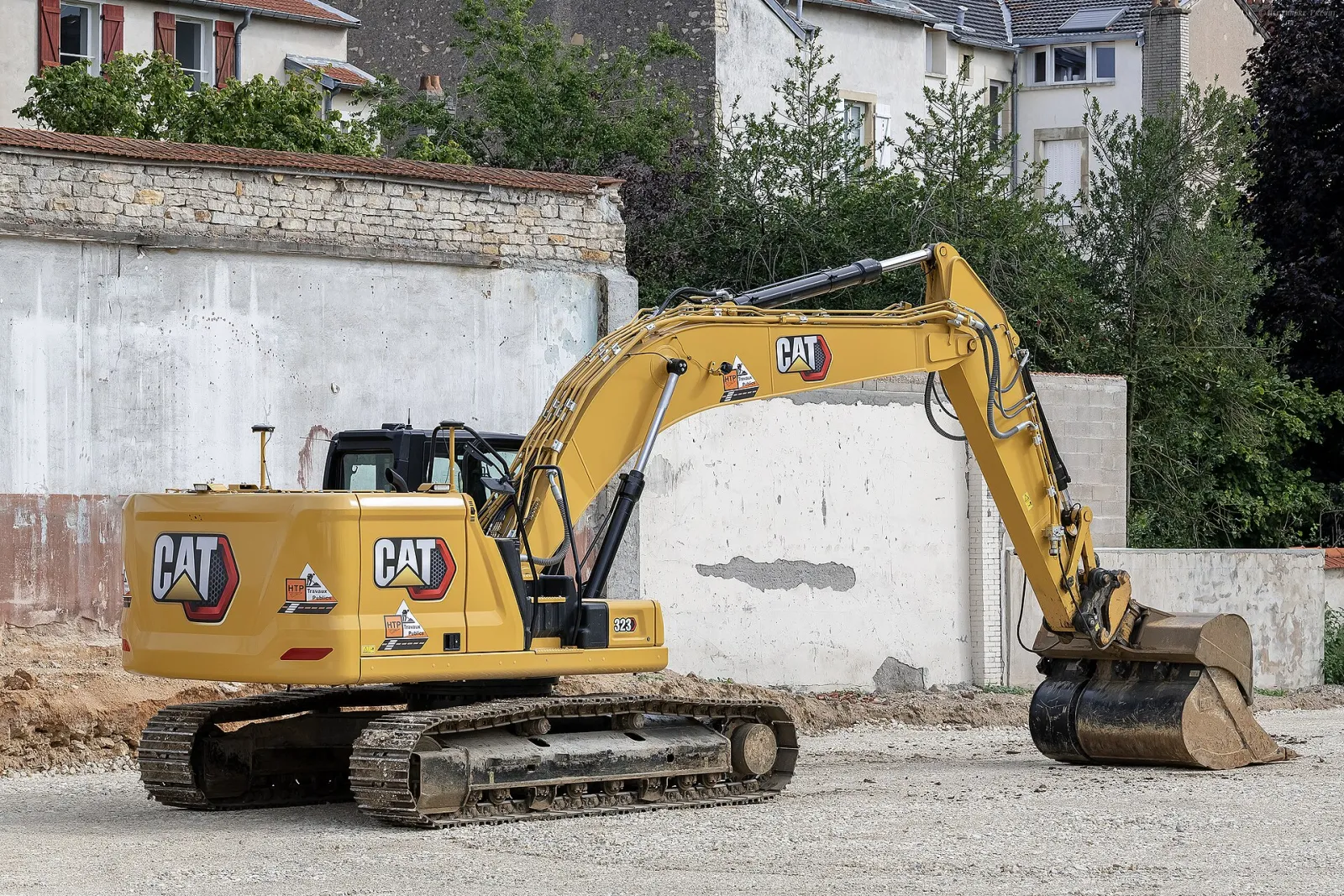
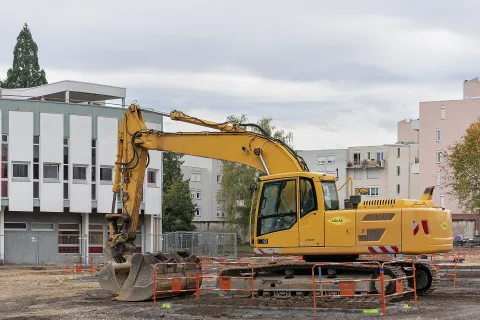
Photo: Alexandre Prevot from Nancy, France, CC BY-SA 2.0 · license
On this page (12 sections) ↓
+Strengths
- Heavier counterweight (5.4 t) and frame give more lift capacity and stability than the 320
- Six-cylinder C7.1 engine with strong low-speed torque
- Same factory Cat Grade, Payload, E-fence and Lift Assist technologies as the 320
- Still transportable like a 20-tonne machine in many regions
- Excellent resale and dealer support
−Watch-outs
- Same hydraulic flow (429 L/min) as the 320, so cycle-time gains come mainly from stability and bucket size
- Higher price and fuel burn than the 320
- Heavier: closer to transport limits with a large bucket and wide shoes
- Tier 4 Final / Stage V aftertreatment needs good DEF and fuel management
The Cat 323 in 30 seconds
- What it is: a ≈25-tonne (55,000 lb) crawler excavator built on the Next Generation 320 platform but heavier and more production-focused.
- Engine: six-cylinder Cat C7.1, 128.5 kW (172 hp) net in Tier 4 Final / Stage V form.
- Headline numbers: 6.73 m (22 ft 1 in) dig depth, 9.87 m (32 ft 4 in) reach, 5.4 t counterweight, 152 kN bucket force with boost.
- Why buy it: more lifting capacity and stability than a 320, with the same technology and transport-friendly size.
- Why not: if you mostly trench and grade, a Cat 320 is cheaper to buy and run.
Overview
Caterpillar introduced the 323 as part of its Next Generation excavator family in 2018. It sits between the 320 and the larger 325 and 330 and replaced the 323F. The idea is simple: take the proven 320 platform, add a heavier counterweight, heavy-duty frame and undercarriage and a six-cylinder engine, and you get a machine that lifts more, carries a larger bucket and stays planted when loading trucks — without the transport penalty of a 30-tonne excavator.
| Cat 320 | Cat 323 | |
|---|---|---|
| Operating weight (typical) | 21.7–22.1 t | ≈24–25 t |
| Engine (current) | C4.4, 4-cylinder | C7.1, 6-cylinder |
| Counterweight | 3.7 or 4.2 t | 5.4 t |
| Hydraulic flow | 429 L/min | 429 L/min |
| Typical bucket | 1.0–1.19 m³ | 1.3–1.38 m³ |
| Best for | All-round digging, grading, trenching | Truck loading, heavy lifting, mass excavation |
Engine
The Cat C7.1 six-cylinder (7.01 L) produces 128.5 kW (172 hp) net in Tier 4 Final / EU Stage V markets, where it uses DOC, DPF and SCR aftertreatment. A simpler Tier 3-equivalent version for less regulated markets is rated at 117 kW (157 hp) at 1,800 rpm. Both run on approved biodiesel blends and HVO renewable diesel.
Even though rated power is the same as the current 320's four-cylinder C4.4, the bigger six-cylinder delivers its torque at lower engine speed, which many operators appreciate in heavy digging. Fuel consumption is somewhat higher than the 320's because the machine carries more weight and usually a larger bucket.
Hydraulics and performance
The 323 shares the 320's main hydraulic system: two pumps totalling 429 L/min (113 gal/min) at 35 MPa (5,075 psi), rising to 38 MPa in Heavy Lift mode and Auto Dig Boost. ISO bucket digging force is 140 kN, or 152 kN (34,205 lbf) with boost. With the 5.7 m HD Reach boom and 2.9 m stick, the 323 digs to 6.73 m (22 ft 1 in) and reaches 9.87 m (32 ft 4 in).
Where the 323 really earns its keep is stability: the 5.4-tonne counterweight and heavy-duty undercarriage let it handle a bigger bucket (around 1.3–1.38 m³) and lift heavier pipe, boxes and manholes. For pass matching with 30–40 tonne trucks, see our guide to loader and truck pass matching and to lifting with an excavator.
Technology
The 323 gets the same factory technology package as the 320:
- Cat Grade with 2D, with Grade Assist that automates boom and bucket while the operator controls the stick; Advanced 2D and 3D available.
- Cat Payload on-board weighing for accurate truck loading.
- E-fence virtual boundaries, Lift Assist load monitoring and Product Link telematics.
See machine control and telematics explained.
Cab and maintenance
The cab is the Next Generation design shared with the 320: 70 dB(A) inside, touchscreen monitor, keyless start with operator ID and optional joystick travel. Maintenance points and intervals match the 320, including the long-life hydraulic return filter and ground-level daily checks. Our maintenance schedule guide covers the typical intervals.
Cat 323 vs rivals
Most competitors offer a "heavy 22" or "light 25" tonne model aimed at the same buyer:
| Rival | Comparison |
|---|---|
| Komatsu PC210LC-11 | Lighter (≈23 t) but higher hydraulic flow; Komatsu's heavier PC240LC-11 is the closer match |
| Volvo EC220E | Heavier configurations reach ≈25.8 t; very comfortable cab |
| Hitachi ZX210LC-7 | Lighter, smoother; the ZX250LC-7 targets the 323's market |
| John Deere 210 P-Tier | Six-cylinder PowerTech engine and 424 L/min; lighter than the 323 |
| Liebherr R 926 | Heavier (26–30 t), more powerful, higher price |
Verdict: pick the 323 if truck loading, lifting or a larger bucket matter more than the lowest purchase price. Use our comparison tool to check figures side by side.
Common problems and buying tips
- Check the aftertreatment history (DPF and SCR) and DEF quality on Tier 4 Final / Stage V machines.
- Check whether Grade, Payload and E-fence functions are installed and activated.
- Inspect the undercarriage, swing bearing and front-end pins; production machines often work hard in quarries and mass excavation.
- Ask a Cat dealer for S·O·S oil analysis history by serial number.
Follow our used excavator inspection checklist and read about transporting heavy equipment: at ≈25 t, the 323 plus a lowboy is closer to legal limits than a 320.
Who should buy it
- Earthmoving contractors who load trucks all day and want a 20-tonne-class transport footprint.
- Utility and pipeline contractors lifting heavy pipe and precast.
- Fleets standardised on Cat that want one technology platform across 320 and 323 machines.
Caterpillar 323 specifications
Key figures
| Operating weight | ≈25,000 kg (55,100 lb) Tier 4 Final / Stage V; 24,100 kg (53,100 lb) Tier 3 version |
|---|---|
| Net power (ISO 9249) | 128.5 kW (172 hp) Tier 4 Final / Stage V; 117 kW (157 hp) Tier 3 |
| Max. digging depth | 6.73 m (22 ft 1 in), R2.9 m stick |
| Max. reach at ground level | 9.87 m (32 ft 4 in) |
| Bucket digging force (ISO) | 140 kN (31,505 lbf); 152 kN (34,205 lbf) with Auto Dig Boost |
| Bucket capacity | up to ≈1.30–1.38 m³ (1.70–1.80 yd³) HD |
Engine
| Engine model | Cat C7.1, six cylinders |
|---|---|
| Displacement | 7.01 L (428 in³) |
| Gross power (ISO 14396) | 129.4 kW (174 hp) Tier 4 Final / Stage V |
| Emissions | US EPA Tier 4 Final / EU Stage V; Tier 3-equivalent version for less regulated markets |
| Renewable fuels | Biodiesel blends and 100% HVO renewable diesel |
Hydraulics
| Main system max. flow | 429 L/min (113 gal/min), 2 × 215 L/min |
|---|---|
| Max. pressure – equipment | 35,000 kPa (5,075 psi); 38,000 kPa (5,510 psi) Heavy Lift / Auto Dig Boost |
| Max. pressure – travel / swing | 34,300 kPa (4,974 psi) / 27,500 kPa (3,998 psi) |
| Stick digging force (ISO) | 107 kN (24,050 lbf); 116 kN with boost, R2.9 m stick |
Swing and travel
| Swing speed | 11.3 rpm |
|---|---|
| Max. swing torque | 82 kN·m (60,300 lbf·ft) |
| Max. travel speed | 5.7 km/h (3.5 mph) |
| Max. drawbar pull | 204 kN (45,861 lbf) |
Working range (5.7 m HD Reach boom, R2.9 m stick)
| Max. cutting height | 9.45 m (31 ft 1 in) |
|---|---|
| Max. loading height | 6.48 m (21 ft 3 in) |
| Max. vertical wall digging depth | 5.62 m (18 ft 5 in) |
| Depth for 2.44 m (8 ft) level bottom | 6.56 m (21 ft 6 in) |
Dimensions and weights
| Counterweight | 5,400 kg (11,900 lb) |
|---|---|
| Tail swing radius | 2.83 m (9 ft 3 in) |
| Cab height | 2.96 m (9 ft 9 in) |
| Track shoes | 600 mm (24 in) standard; 700 or 790 mm (28 or 31 in) optional |
Capacities
| Fuel tank | 345 L (86.6 US gal) |
|---|---|
| Hydraulic system / tank | 234 L / 115 L (61.8 / 30.4 US gal) |
| Engine oil | 25 L (6.6 US gal) |
| Sound in cab (ISO 6396) | 70 dB(A) |
Figures are typical for standard configurations as published by Caterpillar. Values vary by market, emissions tier, attachments and options; confirm with your dealer before purchase, transport or lifting.
Caterpillar 323 vs rivals: specs side by side
Headline figures for standard configurations; “—” means the figure is not listed in our database.
| Specification | Caterpillar 323 | Caterpillar 320 | Komatsu PC210LC-11 | Volvo EC220E | Hitachi ZX210LC-7 |
|---|---|---|---|---|---|
| Type | Excavator | Excavator | Excavator | Excavator | Excavator |
| Operating weight | ≈25,000 kg (55,100 lb) Tier 4 Final / Stage V | 21,200–22,100 kg (46,700–48,700 lb) | ≈23,240 kg (51,231 lb) | 20,470–25,760 kg (45,350–55,360 lb) | 21,900–23,900 kg (48,300–52,700 lb) |
| Net power (ISO 9249) | 128.5 kW (172 hp) Tier 4 Final / Stage V | 128.5 kW (172 hp) | 118.6 kW (159 hp) | 128 kW (172 hp) | 122 kW (164 hp) |
| Max. digging depth | 6.73 m (22 ft 1 in) | 6.72 m (22 ft 1 in) | 6.62 m (21 ft 9 in), 5.7 m boom + 2.9 m arm | ≈6.73 m (22 ft 1 in) | 6.67 m (21 ft 11 in) |
| Max. reach at ground level | 9.87 m (32 ft 4 in) | 9.86 m (32 ft 4 in) | 9.70 m (31 ft 10 in) | — | — |
| Bucket digging force (ISO) | 140 kN (31,505 lbf) | 150 kN (33,811 lbf) | — | — | 158 kN (35,520 lbf) with power boost |
| Bucket capacity | up to ≈1.30–1.38 m³ (1.70–1.80 yd³) HD | 0.53–1.19 m³ (0.69–1.56 yd³) standard range | ≈0.97 m³ (1.27 yd³) standard | — | — |
| Engine model | Cat C7.1 | Cat C4.4 (current) | Komatsu SAA6D107E-3 | — | — |
| Displacement | 7.01 L (428 in³) | 4.4 L (269 in³) | 6.69 L (408 in³) | — | — |
| Gross power (ISO 14396) | 129.4 kW (174 hp) Tier 4 Final / Stage V | 129.4 kW (174 hp) | 122.8 kW (165 hp) | 129 kW (173 hp) | — |
| Emissions | US EPA Tier 4 Final / EU Stage V | US EPA Tier 4 Final / EU Stage V | US EPA Tier 4 Final / EU Stage V | US EPA Tier 4 Final / EU Stage V | EU Stage V / US EPA Tier 4 Final (Tier 3 versions in some markets) |
Caterpillar 323 videos
Walkarounds and demonstrations from the manufacturer and independent channels. Videos load from YouTube only when you press play.
Frequently asked questions
How much does a Cat 323 weigh?
A Tier 4 Final / Stage V Cat 323 weighs about 25,000 kg (55,100 lb). The Tier 3 version with a 1.30 m³ HD bucket and 600 mm shoes weighs about 24,100 kg (53,100 lb).
What engine is in the Cat 323?
The Cat 323 uses the six-cylinder 7.01-litre Cat C7.1, rated at 128.5 kW (172 hp) net in Tier 4 Final / Stage V form and 117 kW (157 hp) in the Tier 3 version.
What is the difference between the Cat 320 and 323?
The 323 is heavier (about 25 t vs 22 t), has a six-cylinder C7.1 engine and a 5.4 t counterweight, and carries a larger bucket. The 320 is lighter, cheaper and better suited to all-round work.
How deep can a Cat 323 dig?
With the 5.7 m boom and 2.9 m stick, maximum digging depth is 6.73 m (22 ft 1 in). With the 2.5 m stick it is about 6.31 m (20 ft 8 in).
What is the fuel tank capacity of a Cat 323?
345 L (86.6 US gal).
What size bucket does a Cat 323 use?
Heavy-duty buckets of about 1.3–1.38 m³ (1.7–1.8 yd³) are typical for truck loading; smaller buckets are used for trenching.
Owner & operator reviews
No reviews yet. Have you owned, operated or serviced a Caterpillar 323? Your experience helps other buyers.
Share your experience with the Caterpillar 323 +
Forum discussions
Have a question about the Caterpillar 323? Ask the community.