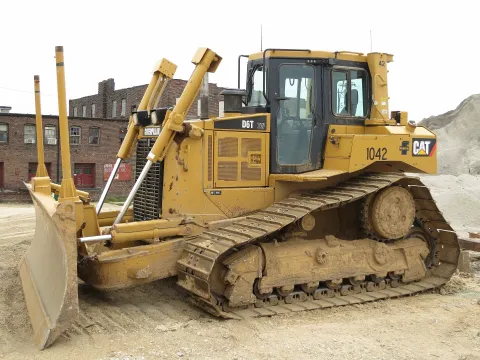
Caterpillar 301.7 CR
Cat’s 1.7-tonne compact-radius mini excavator
The Cat 301.7 CR is a 1.8–1.9 tonne compact-radius mini excavator with a Cat C1.1 engine (15.7 kW / 21 hp), up to 2.54 m dig depth and a retractable undercarriage that narrows to 0.99 m for doorways and gates. Full specs, rivals, transport and buying advice.

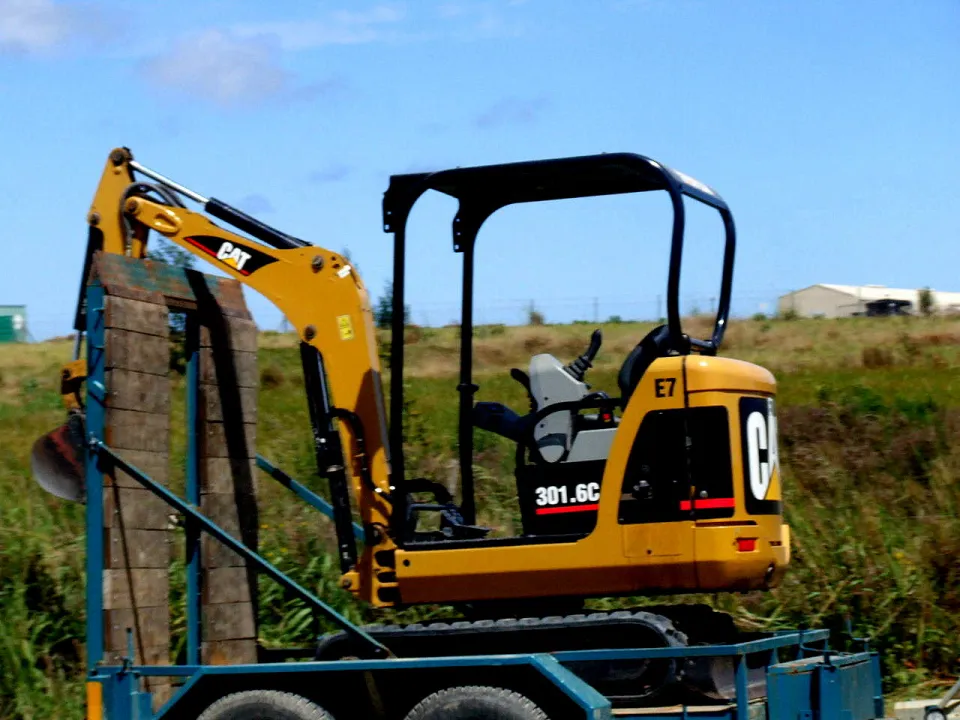
Photo: Bob Adams from Amanzimtoti, South Africa, CC BY-SA 2.0 · license
On this page (15 sections) ↓
+Strengths
- Retractable undercarriage (0.99–1.30 m) fits through gates and doorways yet is stable when extended
- Compact radius: tail stays within 0.65 m when slewing
- Light enough (under 2 t) to tow behind many pickups and vans with a suitable trailer
- Cat dealer support and strong resale for a mini
- Tier 4 Final / Stage V without the complexity of larger engines
−Watch-outs
- Small 3-cylinder engine: slow in hard digging compared with 2.5-tonne machines
- Canopy only in most markets (no enclosed cab)
- Limited lifting capacity — check the chart before lifting
The Cat 301.7 CR in 30 seconds
- What it is: a 1.8–1.9 tonne (3,950–4,220 lb) compact-radius mini excavator.
- Engine: Cat C1.1 three-cylinder, 15.7 kW (21 hp) net.
- Headline numbers: up to 2.54 m (8 ft 4 in) dig depth, 4.06 m reach, retractable tracks from 0.99 to 1.30 m.
- Why buy it: gets through narrow access, is easy to tow and has Cat build quality and support.
- Why not: if access isn't restricted, a 2.5–3 tonne machine digs much faster.
Overview
The 1.5–2 tonne class is where many landscapers, plumbers, fencing contractors and homeowners first meet excavators: these machines fit through garden gates, work inside buildings and travel on light trailers. Caterpillar's 301.7 CR is its main machine in this class. The Next Generation version replaced the 301.7D CR from around 2019, with a new canopy and controls, a C1.1 engine meeting Tier 4 Final / Stage V and refinements to the hydraulics.
The retractable undercarriage is the key feature: the tracks pull in to 0.99 m (39 in) to pass through openings and extend to 1.30 m (51 in) for stability while digging. Combined with a 0.65 m tail swing, the machine can slew close to walls and fences.
The Cat CR mini excavator family
"CR" stands for compact radius: the rear of the machine stays close to the tracks when it swings, so it can work next to walls and in narrow spaces. All the models below meet US EPA Tier 4 Final / EU Stage V. Figures are Caterpillar's (via dealer data) for the heaviest standard configuration with cab.
| Model | Max. operating weight | Net power | Max. dig depth |
|---|---|---|---|
| Cat 301.7 CR | 1,915 kg (4,222 lb) | 15.7 kW (21 hp) | 2.54 m (8 ft 4 in) |
| Cat 302.7 CR | 3,050 kg (6,725 lb) | 17.6 kW (23.6 hp) | 2.71 m (8 ft 11 in) |
| Cat 303.5 CR | 4,190 kg (9,239 lb) | 17.6 kW (23.6 hp) | 3.11 m (10 ft 2 in) |
| Cat 305 CR | 5,755 kg (12,688 lb) | 33.6 kW (45 hp) | 3.67 m (12 ft) |
| Cat 306 CR | 7,151 kg (15,766 lb) | 41.7 kW (55.9 hp) | 4.11 m (13 ft 6 in) |
| Cat 308 CR | 8,388 kg (18,493 lb) | 51.8 kW (69.5 hp) | 4.64 m (15 ft 3 in) |
Caterpillar also builds intermediate sizes (302 CR, 303 CR, 304 CR, 307.5, 309 CR, 310) that are not covered in our database yet.
Engine and hydraulics
The three-cylinder Cat C1.1 produces 15.7 kW (21 hp) net and meets US EPA Tier 4 Final and EU Stage V. At this power level the emissions system is simpler than on larger machines (no DEF). Hydraulics are load-sensing, with a dozer blade and auxiliary hydraulic lines for attachments such as breakers and augers.
Digging performance
With the standard stick the 301.7 CR digs to about 2.35 m; the long stick increases this to 2.54 m (8 ft 4 in) and reach at ground level to 4.06 m. Maximum dump clearance is 2.51 m, enough to load a small tipper or dumper, and the boom swings 65° left and 50° right for digging alongside walls — a feature large excavators lack.
These numbers make the 301.7 CR right for:
- footings and trenches for garden walls, fences and small extensions;
- drainage, water and cable trenches up to about 2 m deep;
- landscaping, ponds, tree planting and stump removal;
- interior demolition and basement work where access is limited.
For deeper foundations or faster production, look at the Cat 302.7 CR or 303.5 CR. Our guide what size excavator do I need explains how to choose.
Attachments
Popular tools include trenching and grading buckets, a hydraulic thumb, a small breaker, an auger drive, a ripper tooth and a compaction plate. A quick coupler speeds up changes. Keep attachment weight within the machine's limits — on a 1.8-tonne excavator a heavy tool noticeably reduces stability. See the excavator attachments guide.
Transport
At under 2 tonnes, the 301.7 CR can be towed on a suitable plant trailer by many pickups and large vans, which is a major reason this class is so popular with hire companies and small contractors. Always check your vehicle's towing limit, the trailer's gross weight rating and local licence rules for the combined weight — machine, trailer and attachments together. Secure the machine with four-point chains. See how to transport heavy equipment.
Operating tips
- Extend the tracks before digging or slewing with a load; retract them only to pass through openings.
- Use the blade as a stabiliser and lower it when digging over the front.
- Mini excavators are easier to tip than large machines — avoid slewing with the bucket high on slopes. See excavator operating tips for beginners.
Maintenance
Daily: engine oil and coolant level, hydraulic oil sight glass, greasing the boom, stick and bucket pins, rubber track tension and condition. Rubber tracks are the largest wear item on minis; avoid turning on sharp rubble and keep tension correct. See how to grease heavy equipment and heavy equipment maintenance schedule.
Cat 301.7 CR vs rivals
| Rival | Comparison |
|---|---|
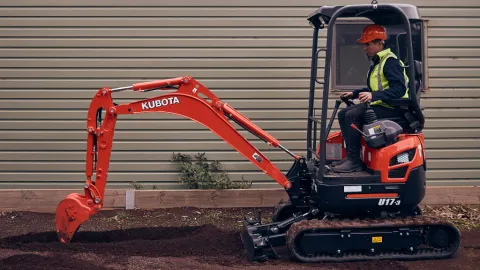
| Kubota U17-3 | Class best-seller; zero tail swing; strong dealer network |
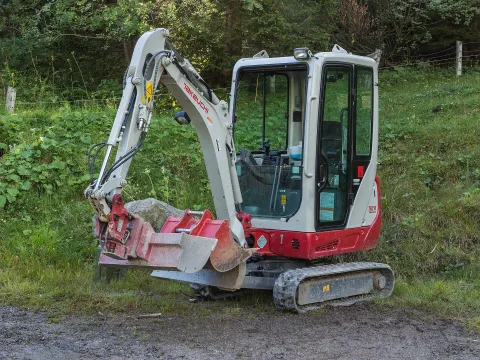
| Takeuchi TB216 | Robust, popular with hire fleets |
| Wacker Neuson EZ17 | Zero tail swing, European design |
| Kobelco SK17SR-5 | Short-radius, smooth controls |
| JCB 19C-1E | Fully electric alternative |
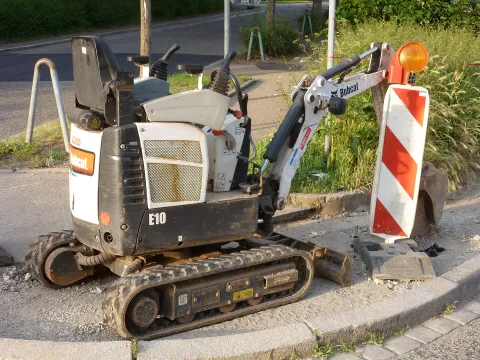
| Bobcat E10e | Smaller 1-tonne electric machine |
Buying a used 301.7 CR
- Check hours and service history (Product Link data where fitted).
- Inspect rubber tracks, sprockets and idlers — replacement tracks are a significant cost.
- Check the retractable undercarriage cylinder and slides for leaks and play.
- Look for play in the boom swing pivot and bucket pins.
- Test all functions, including auxiliary hydraulics and blade.
See our used excavator checklist and the best mini excavators shortlist.
Verdict
The Cat 301.7 CR is a well-built, easy-to-transport mini excavator with a genuinely useful retractable undercarriage. It is ideal for landscapers, small builders and hire fleets working in tight access. If access is not a constraint, the extra power and depth of a 2.5–3.5 tonne machine will pay back quickly.
Caterpillar 301.7 CR specifications
Key figures
| Operating weight | 1,789–1,915 kg (3,946–4,222 lb) with canopy |
|---|---|
| Net power | 15.7 kW (21 hp) |
| Max. dig depth | 2.35–2.54 m (7 ft 9 in–8 ft 4 in), by stick |
| Max. reach at ground level | 3.90–4.06 m (12 ft 10 in–13 ft 4 in) |
| Track width | 0.99 m retracted / 1.30 m extended (39 / 51 in) |
| Tail swing | 0.65 m (25.6 in) |
Engine
| Engine model | Cat C1.1, 3 cylinders, 1.1 L (69 in³) |
|---|---|
| Gross power | 16.1 kW (21.6 hp) |
| Emissions | US EPA Tier 4 Final / EU Stage V |
Working range (standard configuration)
| Max. dig height | 3.49 m (11 ft 5 in) |
|---|---|
| Max. dump clearance | 2.51 m (8 ft 3 in) |
| Vertical wall dig depth | 1.80–1.89 m (5 ft 11 in–6 ft 2 in) |
| Boom swing (left / right) | 65° / 50° |
Dimensions
| Shipping length | 3.59 m (11 ft 9 in) |
|---|---|
| Shipping height | 2.30 m (7 ft 7 in) |
| Undercarriage length | 1.59 m (5 ft 3 in) |
| Rubber track width | 230 mm (9.1 in) |
| Ground clearance | 140 mm (5.5 in) |
| Blade height / depth | 269 mm / 264 mm (10.6 / 10.4 in) |
Options
| Option weights | Long stick +10 kg; steel tracks +50 kg; heavy counterweight +67 kg |
|---|
Figures are typical for standard configurations as published by Caterpillar. Values vary by market, emissions tier, attachments and options; confirm with your dealer before purchase, transport or lifting.
Caterpillar 301.7 CR vs rivals: specs side by side
Headline figures for standard configurations; “—” means the figure is not listed in our database.
| Specification | Caterpillar 301.7 CR | Kubota U17-3 | Takeuchi TB216 | Bobcat E10e | Wacker Neuson EZ17 |
|---|---|---|---|---|---|
| Type | Mini excavator | Mini excavator | Mini excavator | Mini excavator | Mini excavator |
| Operating weight | 1,789–1,915 kg (3,946–4,222 lb) with canopy | 1,675 kg (3,693 lb) | 1,770 kg (3,900 lb) | ≈1,176–1,201 kg (2,590–2,648 lb) | ≈1,724–2,083 kg (3,800–4,600 lb) |
| Max. dig depth | 2.35–2.54 m (7 ft 9 in–8 ft 4 in) | — | 2.39 m (7 ft 10 in) | ≈1.82 m (6 ft) | ≈2.5–2.6 m (8 ft 2 in–8 ft 6 in) |
| Tail swing | 0.65 m (25.6 in) | — | — | Zero tail swing | Zero tail swing |
| Engine model | Cat C1.1, 3 cylinders, 1.1 L (69 in³) | Kubota D902, 3 cylinders, 898 cc | — | — | — |
| Ground clearance | 140 mm (5.5 in) | 150 mm (6 in) | — | — | — |
Caterpillar 301.7 CR videos
Walkarounds and demonstrations from the manufacturer and independent channels. Videos load from YouTube only when you press play.
Frequently asked questions
How much does a Cat 301.7 CR weigh?
Between 1,789 kg (3,946 lb) and 1,915 kg (4,222 lb) with canopy, depending on options.
How deep can a Cat 301.7 CR dig?
About 2.35 m with the standard stick and up to 2.54 m (8 ft 4 in) with the long stick.
How wide is the Cat 301.7 CR?
The undercarriage retracts to 0.99 m (39 in) for narrow access and extends to 1.30 m (51 in) for stability.
What engine is in the Cat 301.7 CR?
A three-cylinder Cat C1.1 producing 15.7 kW (21 hp) net, meeting Tier 4 Final and Stage V.
Can I tow a Cat 301.7 CR with a pickup?
Often yes, on a suitable plant trailer, because the machine weighs under 2 tonnes. Check your vehicle’s towing capacity, the trailer rating and local licence rules for the combined weight.
What does CR mean on Cat mini excavators?
Compact radius: the rear of the machine stays close to the tracks when it slews, so it can work near walls and obstacles.
Owner & operator reviews
No reviews yet. Have you owned, operated or serviced a Caterpillar 301.7 CR? Your experience helps other buyers.
Share your experience with the Caterpillar 301.7 CR +
Forum discussions
Have a question about the Caterpillar 301.7 CR? Ask the community.